Thursday, November 3, 2011

'It was not something that I was very eager to see'

The Emmy Award-winning documentary Ashes to Glory debuted to rave reviews in 2000. The film about the 1970 Marshall University plane crash inspired viewers. But for many people like MU alumna Angela Dodson, it would be years after the documentary’s release before they could muster up enough nerve to watch a film that  brought back so many painful memories. Dodson, a free-lance writer, editor and consultant, was a sophomore journalism major at the time of the tragedy.
Q: How long did you have Ashes to Glory in your possession before you finally decided to take a look at it?
Angela Dodson
A: I’m not certain. But it would be safe to say at least two or three years. I bought it at the Marshall Bookstore, I believe. I can’t pinpoint the year because I had been visiting (MU) campus at least annually because I was on the Yeager Scholars’ board. I’m sure it was after the We Are Marshall film came out.
Q: You mentioned that even though you had the documentary DVD for a few years, the seal had not been broken. Sounds like you had no intentions of looking at it for a very long time, if ever. Please elaborate.
A: I guess I didn’t have any real intentions of viewing it. I can’t say I ever articulated that, or had a specific reason to avoid it. Obviously, it was not something that I was very eager to see. I’d been told that I was in it somewhere, but I was still not compelled to see it.
Q: Tell me about the film segment you appear in.
A: It’s nearly three-quarters of the way through the documentary and they’re discussing the aftermath of the crash. It’s a press conference, apparently to introduce the new coach. You see me facing the camera, sitting at a table with other reporters, diligently taking notes and looking down at my notebook.
You will recognize me as the girl with the perfect 10-inch-high Afro. I don’t really recall this press conference, but I assume that I was sent on assignment for The Parthenon, the campus newspaper, as part of an advanced reporting class. I wasn’t working for the local paper yet. I guess I could probably figure out the date and research whether I did a story on it. I might have just contributed to a larger story.
Because of my experience and my role as a student reporter in covering the 1970 Marshall crash, I’ve had a life-long fascination and interest in disaster news coverage, which has served me especially well as an editor. I could work calmly through nights of editing news and coordinating the coverage of train wrecks, mine disasters, massive fires, explosions and earthquakes, not to mention plane crashes, and I would continuously push to get every detail.

Tuesday, November 1, 2011

Author's response to comment on news column

        There’s further need to set the record straight about the rationale for my views about the film We Are Marshall. Sure enough, the movie gave the MU story a national stage. But just because a story draws interest from sea to shining sea doesn’t set a precedent for distorting what really happened.
       Below, a Winston-Salem Journal (NC) reader, who is also a Marshall graduate, commented on a recent newspaper column about the memoir November Ever After.
       As the book’s author, I have a response, which follows the reader’s comments.
       Kerrie Barnhart wrote:
       “We Are Marshall has a runtime of two hours, 11 minutes. The horror of the night of November 14, 1970 took longer than that. There were so many sad, interesting and (eventually) wonderful stories that began that evening, but there's simply no way they could have all been included in a two-hour movie. With all due respect to Mr. Greenlee, nearly five years after the release of "WAM," I just don't understand the animosity about decisions that had to be made for a movie's running time.”
       Greenlee’s response:
       I agree wholeheartedly that there’s only such much content that can be squeezed into a movie that last a little over two hours. The real issue here is not a film’s run time. It’s about making sure that – within the time frame of the movie – that the truth be fully acknowledged.
       That’s not too much to ask, especially when you recall this sentence … “This is a true story.” Those words appeared prominently on the screen at the very start of the movie.
       The whole focus of the film was to show how a college and a city managed to recover from such a shocking loss. Yet, it’s so strange that the movie never gave much information about the seventy-five passengers who died in that plane crash. If there’s no tragedy, there’s no comeback, and hence, no story line.
       No movie, or documentary, or book can be all-inclusive. Not many people will sit through a movie that’s longer than two-and-half hours. Books are no different. How many people will read 500, 800 or 1,000 pages of somebody’s prose?
       Here’s the bottom line. The movie was produced as an avenue to pay homage to those who lost their lives on a November night a long time ago. If we’re serious about that, what better way to honor them than to tell it like it really was?
       And even if you can’t get every aspect of the story in, it’s no problem. Take the content you have and tell it thoroughly, tell it well, and don’t forsake accuracy for the sake of artistic license.
       Are the people from back in the day way off base because they prefer the truth over an altered version of what really transpired? I don’t think so. Let’s just say that it’s so sad that filmmakers are convinced they can improve the truth by improvising.
       This story is truly marvelous. There’s no need for alterations.
  

Monday, October 31, 2011

NC columnist: 'Setting the Marshall story straight'

       It’s always been my belief that the memoir November Ever After has unlimited appeal. Yes, the story of the 1970 Marshall University football plane crash has special meaning to anyone with a connection to the school and/or the state of West Virginia.
       Even so, the story’s appeal transcends Marshall and the “Mountain State.”
       In today’s blog entry, newspaper columnist Scott Sexton gives his take on the Marshall saga and book author Craig T. Greenlee. Click on the link below to read this column, which ran in the Winston-Salem Journal (NC) on October 23.
 

Sunday, October 30, 2011

Aftermath: A cry of anguish on a college campus


       Editor’s Note: The following quote came from Marshall University’s student body president in the aftermath of the 1970 plane crash. (Source: Chief Justice yearbook, 1970-71 school year).

       "There is no one untouched. 
There is no one who can hear 
of this and not feel sorrow and grief. 
And we, the students, 
feel the pain so deeply
that we cry …
and cry …
and wonder how, and why."

Michael Gant
Marshall University
Student Body President

Saturday, October 29, 2011

TONIGHT: Guest appearance on sports talk show

       The author of the memoir November Ever After is set to make a guest appearance tonight on a blog talk radio podcast. Veteran sports journalist Craig T. Greenlee will discuss his book on Three Point Stance: The Leatherheads College Football Hour, which airs on Saturdays from 9-10 p.m. EST. Host Pete Sonski is joined by co-host Joe Williams
       The show is divided into two segments. The first 30 minutes is a recap of today’s college football games and news. Greenlee’s live interview is scheduled for the show’s guest segment, which comes on the air tonight (10-29) at 9:30.
      Greenlee is a former Marshall University defensive back who played in the late ‘60s/early ‘70s. He was in school at the time of the plane crash that killed most of the football team. As a former teammate, he knew most of the players who were on the plane. After the crash, Greenlee rejoined the team to take part in the rebuilding efforts in the spring of ’71.
       To listen in, click on the following link:


       Care to comment or share an observation? Call (619) 639-4706.

Friday, October 28, 2011

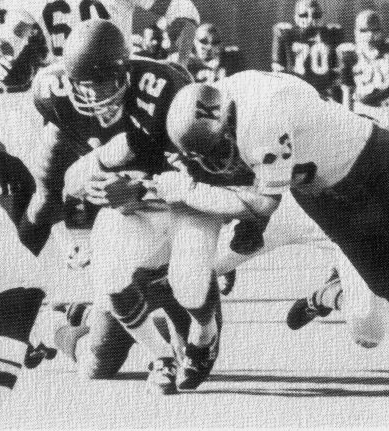
1970 team won its final game at Fairfield Stadium

QB Bob Harris passed for 100 yards vs. Kent State.
       The 1970 Marshall football team suffered a gut-wrenching defeat in the last game it would ever play – a 17-14 road loss to East Carolina.
       What’s often overlooked is that a week before the November 14th plane crash, the Thundering Herd gave the crowd at Fairfield Stadium much to cheer about with a 20-17 comeback win over Kent State. It was the Herd’s final home game for that season.
       The victory, which snapped a four-game losing streak, generated renewed optimism that Marshall was due to experience better days. MU’s record improved to 3-5 with two games left on the schedule. If the Herd could post back-to-back road wins, it would guarantee a break-even season. Pulling that off would have been a coupe of sorts. Marshall had not finished a season at .500 or better since 1965.
       Joe Hood led a revived ground attack that chewed up the Golden Flashes for 232 rushing yards. Hood, a gifted sophomore, finished with 122 yards on 24 carries. He scored what proved to be the game-winner on a 2-yard touchdown run early in the fourth quarter. The Herd trailed 14-10 at the half.
       Backup quarterback Bob Harris, in the third start of his varsity career, connected on 10 of 18 passes for 100 yards and one touchdown. Place-kicker Marcello Lajterman added two field goals.
       Cornerback Larry Sanders led the defense with 12 tackles. Tom Brown and Art Shannon finished with 10 tackles each.